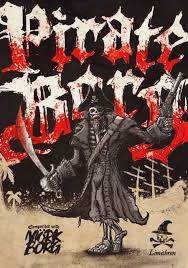
Pirate Borg is a TTRPG using the framework of MÖRK BORG focusing on the golden age of pirates. Pirate Borg was created by Luke Stratton and Limithron. Limithron did not provide compensation in exchange for this review, but I met the team at PaxEast and they generously offered a discount on the Pirate Borg Starter Set to help with the TTRPG Book Club show we did on DM Tales’ YouTube channel. We’ll discuss the core book here and then the Starter Set, which includes a ton of cool stuff.
TTRPG Book Club
I recently participated in the monthly TTRPG Book Club show on DM Tales’ YouTube channel, which you can see here. The book club features a few folks discussing the book and the game. It’s streamed live so anyone can chat and comment, and if you’re a supporter of DM Tales you can join the Discord channel and participate in discussions and ask questions which might be brought to the show.
The Book Design
The Pirate Borg Core Rulebook has the aesthetic common to other ‘Borg games—it looks like a ‘zine from the ‘80s. That means it looks as good as it plays. To that end, many of the spreads look intentionally rough. It’s generally readable despite that aesthetic. The core book is 168 digest size pages. The font choices give the book a gritty feel, but they are also in line with the metal type font designs that would have been popular in the late 1700s and early 1800s.
The Setting
Pirate Borg is set in the Dark Caribbean. It uses the names of real places like Nassau or Jamaica, but uses them to create fantastic dark scenarios. Characters deal with groups inspired by real life forces such as the British and French as well as necromancers and ghosts. The setting works with Ash, a substance made of the remains of destroyed undead, that has psychedelic and physiological effects, determined with random tables.
Characters
Pirate Borg uses 6 basic character classes:
BRUTE a tough warrior, like barbarians
RAPSCALLION a sneaky rogue
BUCCANEER trackers and survivalists, good at ranged weapons. like rangers
SWASHBUCKLER fighters
ZEALOT like a cleric, they use relics and rituals. They worship ancient gods, the one true god, or nature
SORCERER relies on magic from spirits and ghosts.
Each class is similar to classes from traditional games like Dungeons & Dragons and Pathfinder. These classes make sense and having them relate to common tropes makes it easier for new players coming to this game from other games. The Buccaneer sticks out to me as not making a lot of sense in the genre. There were certainly those good at survival in pirate crews and lots of people must have been great with ranged weapons, but typing those things together doesn’t seem to make sense, except that the Ranger class in most recent D&D editions has commonly become proficient in ranged weapons.
The book states that characters who don’t fit one of these classes don’t have a class and are called Landlubbers. It seems that Landlubbers is essentially a class of its own, albeit one without special abilities.
Beyond the standard classes, there’s also options for playing Tall Tales such as merfolk or sentient animals or Haunted Souls who have passed on but still act in the real world.
Characters are built with five ability scores: Strength, Agility, Presence, Toughness, Spirit. At character creation these ability scores are determined by rolling 3d6, but the roll determines the character’s modifier and only that modifier is recorded on the character sheet.
Game Mechanics
The game uses the typical six (seven if you include the %) dice. The book is filled with random tables, and in many cases the players can choose to pick an option or randomly determine their choice using dice.
Combat uses a d20 for to-hit rolls, and uses variable damage. Initiative uses a d6, but is really a coin flip, with either the characters or their adversaries acting first, then the other side acting second. There’s also 2d6 tables to determine Reactions and Morale for opponent NPCs.
The rules are very simple and can be understood quickly. There’s an entire chapter of random generators to build nearly everything from ships to treasure maps to quests.
Damage and Death
Each character’s class determines their Hit Points. Hit points work similarly to other systems, but there are interesting options when a character nears death. When a character reaches zero HP they roll on a d6 table with results carrying from instant death to merely being unconscious for a few rounds. If a character reaches negative HP they are dead, but the book suggests an option (with the agreement of the GM and the player) that the character could come back as a Haunted Soul.
Character Advancement
Characters don’t have explicit levels, but they can become more powerful as they gain experience. The game doesn’t really use XP or a milestone system—it says that the GM decides when a character should improve. This might seem strange or even off-putting to some, but it allows for character advancement to fit directly into the emerging story.
Character improvement happens by increasing abilities, increasing HP, gaining a class feature or finding cool things.
Meta Currency
Devil’s Luck is a meta currency that players have that influences the story. The player can use it for many things: dealing maximum damage, rerolls, neutralize a crit or fumble, etc. Each character starts with some Devil’s Luck and when it’s completely depleted the character can regain some by resting at least 6 hours.
Naval Combat
The naval combat rules are very impressive and could be modified for many other game systems. Each ship has its own HP (the crew and ship’s health) and skills. Each character has a job on the ship. Each round the ship gets 2 crew actions plus one for each character. There are options for specialty crew too.
Creatures
Creatures are organized by the way they move: by sea, by ground or by air. There are the expected monsters such as zombies and skeletons. The section describing how to make your own monster is simple enough to fit on one page. It consists of 5 tables allowing the GM to roll randomly or choose appropriate options or combine both.
The Adventure
The core book contains an adventure called The Curse of Skeleton Point. The adventure is a complete sandbox in that there’s no linear plot. There are detailed NPCs and locations and rumors that can serve to start a story arc.
The Starter Set
The Pirate Borg Starter Set does not contain the core rulebook, but it contains all the rules and more to play the game. The basic rules are printed on the inside of the box top and bottom which can be used as a sort of GM screen. There are five poster maps (18” x 24”) printed on both sides. There are two books: the Player’s Guidebook which contains all the rules needed to create characters and play the game, and Trapped in the Tropics, an introductory adventure designed to teach the rules. There are a few pages of heavy cardboard tokens and markers. There are many cards that detail creatures, ships and more. There’s a black and white set of dice that includes a “two sided die”—a coin with a skull and crossbones on one side. It includes a pad of paper character sheets, and six dry erase reusable character sheets (and two dry erase markers.) This PDF shows the contents of the Starter Set (images from Limithron).
Pirate Borg is a fun game if you’re into the genre. The core book is still available and is affordable in PDF. The starter set is well worth the money and has all you need to play the game. It’s a simple game to learn, and there are many new supplements out, and coming soon.
Pirate Borg is a TTRPG using the framework of MÖRK BORG focusing on the golden age of pirates. Pirate Borg was created by Luke Stratton and Limithron. Limithron did not provide compensation in exchange for this review, but I met the team at PaxEast and they generously offered a discount on the Pirate Borg Starter Set to help with the TTRPG Book Club show we did on DM Tales’ YouTube channel. We’ll discuss the core book here and then the Starter Set, which includes a ton of cool stuff.
TTRPG Book Club
I recently participated in the monthly TTRPG Book Club show on DM Tales’ YouTube channel, which you can see here. The book club features a few folks discussing the book and the game. It’s streamed live so anyone can chat and comment, and if you’re a supporter of DM Tales you can join the Discord channel and participate in discussions and ask questions which might be brought to the show.
The Book Design
The Pirate Borg Core Rulebook has the aesthetic common to other ‘Borg games—it looks like a ‘zine from the ‘80s. That means it looks as good as it plays. To that end, many of the spreads look intentionally rough. It’s generally readable despite that aesthetic. The core book is 168 digest size pages. The font choices give the book a gritty feel, but they are also in line with the metal type font designs that would have been popular in the late 1700s and early 1800s.
The Setting
Pirate Borg is set in the Dark Caribbean. It uses the names of real places like Nassau or Jamaica, but uses them to create fantastic dark scenarios. Characters deal with groups inspired by real life forces such as the British and French as well as necromancers and ghosts. The setting works with Ash, a substance made of the remains of destroyed undead, that has psychedelic and physiological effects, determined with random tables.
Characters
Pirate Borg uses 6 basic character classes:
BRUTE a tough warrior, like barbarians
RAPSCALLION a sneaky rogue
BUCCANEER trackers and survivalists, good at ranged weapons. like rangers
SWASHBUCKLER fighters
ZEALOT like a cleric, they use relics and rituals. They worship ancient gods, the one true god, or nature
SORCERER relies on magic from spirits and ghosts.
Each class is similar to classes from traditional games like Dungeons & Dragons and Pathfinder. These classes make sense and having them relate to common tropes makes it easier for new players coming to this game from other games. The Buccaneer sticks out to me as not making a lot of sense in the genre. There were certainly those good at survival in pirate crews and lots of people must have been great with ranged weapons, but typing those things together doesn’t seem to make sense, except that the Ranger class in most recent D&D editions has commonly become proficient in ranged weapons.
The book states that characters who don’t fit one of these classes don’t have a class and are called Landlubbers. It seems that Landlubbers is essentially a class of its own, albeit one without special abilities.
Beyond the standard classes, there’s also options for playing Tall Tales such as merfolk or sentient animals or Haunted Souls who have passed on but still act in the real world.
Characters are built with five ability scores: Strength, Agility, Presence, Toughness, Spirit. At character creation these ability scores are determined by rolling 3d6, but the roll determines the character’s modifier and only that modifier is recorded on the character sheet.
Game Mechanics
The game uses the typical six (seven if you include the %) dice. The book is filled with random tables, and in many cases the players can choose to pick an option or randomly determine their choice using dice.
Combat uses a d20 for to-hit rolls, and uses variable damage. Initiative uses a d6, but is really a coin flip, with either the characters or their adversaries acting first, then the other side acting second. There’s also 2d6 tables to determine Reactions and Morale for opponent NPCs.
The rules are very simple and can be understood quickly. There’s an entire chapter of random generators to build nearly everything from ships to treasure maps to quests.
Damage and Death
Each character’s class determines their Hit Points. Hit points work similarly to other systems, but there are interesting options when a character nears death. When a character reaches zero HP they roll on a d6 table with results carrying from instant death to merely being unconscious for a few rounds. If a character reaches negative HP they are dead, but the book suggests an option (with the agreement of the GM and the player) that the character could come back as a Haunted Soul.
Character Advancement
Characters don’t have explicit levels, but they can become more powerful as they gain experience. The game doesn’t really use XP or a milestone system—it says that the GM decides when a character should improve. This might seem strange or even off-putting to some, but it allows for character advancement to fit directly into the emerging story.
Character improvement happens by increasing abilities, increasing HP, gaining a class feature or finding cool things.
Meta Currency
Devil’s Luck is a meta currency that players have that influences the story. The player can use it for many things: dealing maximum damage, rerolls, neutralize a crit or fumble, etc. Each character starts with some Devil’s Luck and when it’s completely depleted the character can regain some by resting at least 6 hours.
Naval Combat
The naval combat rules are very impressive and could be modified for many other game systems. Each ship has its own HP (the crew and ship’s health) and skills. Each character has a job on the ship. Each round the ship gets 2 crew actions plus one for each character. There are options for specialty crew too.
Creatures
Creatures are organized by the way they move: by sea, by ground or by air. There are the expected monsters such as zombies and skeletons. The section describing how to make your own monster is simple enough to fit on one page. It consists of 5 tables allowing the GM to roll randomly or choose appropriate options or combine both.
The Adventure
The core book contains an adventure called The Curse of Skeleton Point. The adventure is a complete sandbox in that there’s no linear plot. There are detailed NPCs and locations and rumors that can serve to start a story arc.
The Starter Set
The Pirate Borg Starter Set does not contain the core rulebook, but it contains all the rules and more to play the game. The basic rules are printed on the inside of the box top and bottom which can be used as a sort of GM screen. There are five poster maps (18” x 24”) printed on both sides. There are two books: the Player’s Guidebook which contains all the rules needed to create characters and play the game, and Trapped in the Tropics, an introductory adventure designed to teach the rules. There are a few pages of heavy cardboard tokens and markers. There are many cards that detail creatures, ships and more. There’s a black and white set of dice that includes a “two sided die”—a coin with a skull and crossbones on one side. It includes a pad of paper character sheets, and six dry erase reusable character sheets (and two dry erase markers.) This PDF shows the contents of the Starter Set (images from Limithron).
Pirate Borg is a fun game if you’re into the genre. The core book is still available and is affordable in PDF. The starter set is well worth the money and has all you need to play the game. It’s a simple game to learn, and there are many new supplements out, and coming soon.