
Ravenloft is a demiplane of gothic horror, comprising many realms led by a dark lord, many inspired by tales from literature. There’s many types of horror lurking in these lands, but is it too limited? Could there be even more? Let’s look at what other horrors could lurk in the demiplane. We’ll begin with a brief review of the setting and its history, but if you’d prefer to jump right into what could be in the darkness, skip ahead to “Ravenloft – What Else?”
Ravenloft —The Basics
Ravenloft began as a module for Advanced Dungeons & Dragons (1e), written by Tracy and Laura Hickman and published by TSR in 1983. Inspired by Bram Stoker’s Dracula, it has the vampire Count Strahd von Zarovich as its core villain and attempts to bring a gothic horror tone to D&D. The adventure was amazingly popular, spawning a sequel (Ravenloft II: The House on Gryphon Hill) in 1986.
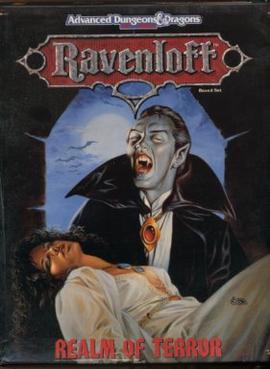
In 1990 Ravenloft was expanded to a demiplane of 34 horror themed domains with the box set Realm of Terror for AD&D second edition. Ravenloft adventures have been published in every edition of D&D since 1983, and there will be a new Ravenloft book, Ravenloft: The Horrors Within, larger in 2026, featuring 16 new domains.
If you’re interested in the history of Ravenloft, check out my friend Daddy Rolled a 1’s video covering that history
Realms of Ravenloft
Barovia is the domain of the great vampire Count Strahd von Zarovich. While he’s a stand-in for Dracula, the scenario in the module doesn’t directly follow the plot of Bram Stoker’s Dracula, or of any of the movies. Other domains are inspired by famous horror tropes and stories such as werewolves, Frankenstein, the Marquis de Sade, mummies and The Strange Case of Dr. Jekyll and Mr. Hyde.
Though the stories that inspired these domains are from different time periods, all of them are modified to fit in the medieval/Renaissance technology and settings common to most D&D campaigns. Here’s just a few domains that are defined in the fifth edition Van Richten’s Guide to Ravenloft.
Bluetspur
The domain of Bluetspur is ruled by the God-Brain of Bluetspur, a dying great creature of Lovecraftian tone. Bluetspur is the closest thing we have to a “different” sort of domain. It’s controlled by Mindflayers and the lands are depicted as strange and alien to align with its Lovecraftian roots. It’s not truly a different experience than a standard D&D adventure because the characters’ armor, swords and bows are still core to the domain and function mostly as expected.
Borca
Borca is a domain ruled by two lords, Ivana Boritsi and Ivan Dilisnya. The setting is a domain of intrigue and double-crossing among the noble families of the domain. It could be an interesting place for an adventure as the tone could stray to anywhere from mafia stories to a tale by Oscar Wilde. But the setting still conforms to the usual D&D tech levels and themes.
Falkovnia
Falkovnia is a land besieged by zombies. Although it draws from all the zombie tropes of horror movies, comic books and television, the latest portrayals are understandably skewed towards The Walking Dead. Although zombie movies tend to be in the present day (i.e., whatever time they’re released) or the near future, Falkovnia is modified to conform to the usual D&D settings.
Har’Akir
Har’Akir is a domain inspired by tales of Egyptian mummies, its ruler Ankhtepot being the mummy of a high priest. The Gods of the land of Har’Akir are direct takes on Egyptian Gods, with their names often altered by a single letter. What’s interesting—and/or confusing—about this setting is that it seems to take place during the time of the Pharaohs, while mummy stories usually take place in a later period, when unearthing ancient tombs was not discouraged. In any case the technology level is moved towards the medieval to conform to a typical D&D campaign.
Lamordia
Lamordia is a domain whose dark lord is Viktra Mordenheim, a “scientist” who created horrific constructs. Interesting to note that the 1990 Ravenloft Realm of Terror boxed set listed Mordenheim’s creature Adam as the dark lord of this domain. The constructs here use common D&D creature stat blocks such as golems. While the Frankenstein novel that inspired this domain was published in 1818, the themes here take place in a typical D&D setting.
Ravenloft – What Else?
Yes, what else? Why am I asking this question? Because we might create something even more interesting if we break a few assumptions. As noted above, although the domains of Ravenloft are inspired by stories that take place in many disparate time periods, they’re all distilled down to fit into the pre-Renaissance themes of traditional D&D settings. But if Ravenloft is truly a place of every type of horror, could we expand it to do more? Note: if you’re the type of player who would hate allowing guns—nevermind lasers—in your D&D games, you might need to stop here. But, for those brave souls, let’s move forward!
Sci-Fi Horror
Characters often arrive in a domain of Ravenloft by emerging from the mist to find themselves on a desolate road or outside of a village. Instead, they might find themselves emerging from the mists to hear their boots clank on the metallic floors of a space ship. Alien creatures are everywhere using computer screens they’ve never seen before. Food is created by replicators and travelling across galaxies is accomplished in minutes. But a giant space devourer hungering to eat all living flesh crawls towards them from the cargo bay as the ship’s emergency sirens blare.
There are all sorts of examples of horror in science fiction, from the Xenomorphs of the Alien movies to the isolation of travelers in Silent Running or 2001: A Space Odyssey. By not translating these stories to a medieval fantasy world, you can use the feeling of being out of place for the characters to increase the stress for them. The challenge for a GM in running this situation is in maintaining that balance while keeping the fun of a challenging game. The characters have never seen a keyboard or computer screen before, but continually using that as a blocker will frustrate the players. It should challenge them, not stand in their way, cancelling any strategies they come up with. They have never seen a laser rifle before, but treating it like wild magic instead of saying they simply can’t use it will make the emerging story more fun.
Future and Post-Apocalyptic Horror
The characters emerge from the mists to find themselves in a huge city of metal buildings taller than they’ve ever seen, but no people are found. After hours of searching as the sun sets they spot a human coming towards them. Running towards them. Running directly at them. It screeches, opening its mouth wide to bear its fangs?
When D&D characters first encounter a modern or near future civilization they will feel out of place, but it isn’t long before they encounter the threats of stories such as I Am Legend, Mad Max, or A Quiet Place. For these stories it’s best to use NPC survivors to help show the contrast between the story’s setting and the world the D&D characters came from. The characters might be immune to the engineered virus of I Am Legend, but the pseudo vampires still attack. The crazed survivors of Mad Max could use the characters’ help, even if the characters have no idea why they need gasoline so badly. The creatures of A Quiet Place might be epically dangerous, but what if the wizard’s Silence spell works (although they can’t replenish spell slots?). `RTT
Prehistoric Horror
For horror with the feeling of being out of place, it’s hard to beat the characters finding themselves in a prehistoric world. There’s many stories to take as inspiration, from The Lost World and 1,000,000 Years BC to King Kong or Jurassic Park.
The GM first needs to decide how they’ll deal with historical realism. 1,000,000 Years BC had humans living alongside dinosaurs, to many grumbling complaints. But you can have the characters enter the world as the only humanoids which avoids that issue. The bigger issue will be deciding how many dinosaurs of which sorts you will feature. In real life Tyrannosaurus Rex lived about 80 million years after Stegosaurus became extinct. You could deal with this in realistic terms by only having dinosaurs of a particular era appear. But you’re creating a fantastic domain, so it’s likely more fun to just decide to mix it up.
The characters will find themselves without being able to replenish arrows, buy supplies or easily find food, adding to the horror.
Conclusion
Many of the ideas I’ve suggested here likely won’t be welcomed for an entire long campaign. If your players arrive at your D&D campaign with their elven rogue character and find themselves jetting through space as rebels fighting the Empire, they might balk. But they may find that while traversing the horrific domains of Ravenloft, a shorter adventure in a very different domain could be interesting and challenging.
This would be a reimagining of Ravenloft: it’s not only a setting of medieval horror, it can be a setting of horror taking place across all time periods, any technology level or themes.
What do you think, let us know what you’d like to do with Ravenloft!
Self Publishing Tip
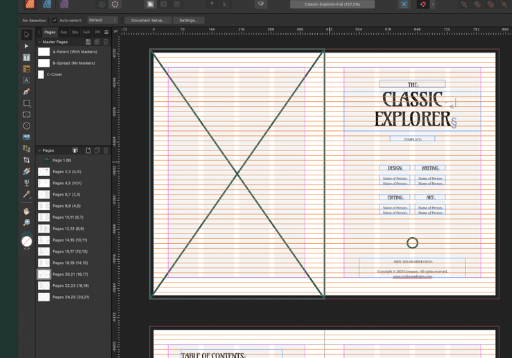
Thanks to JP Coovert for the tip on this one. If you’re planning on doing the layout for a pub lished project and would like to get some hints, download this Classic Explorer package from Clayton Notestine. It includes templates for Adobe InDesign and Affinity as well as tons of advice and explanation.
About the Author

My brother, many years ago, ran a long Ravenloft campaign, and included an Island of Dr. Moreau themed realm, and an Eternia (of He-Man Masters of the Universe) themed realm. These were fun, but often played for laughs, which is the real weakness of the setting. Ravenloft would be more compelling as a setting with a set of game mechanics more geared toward horror.