
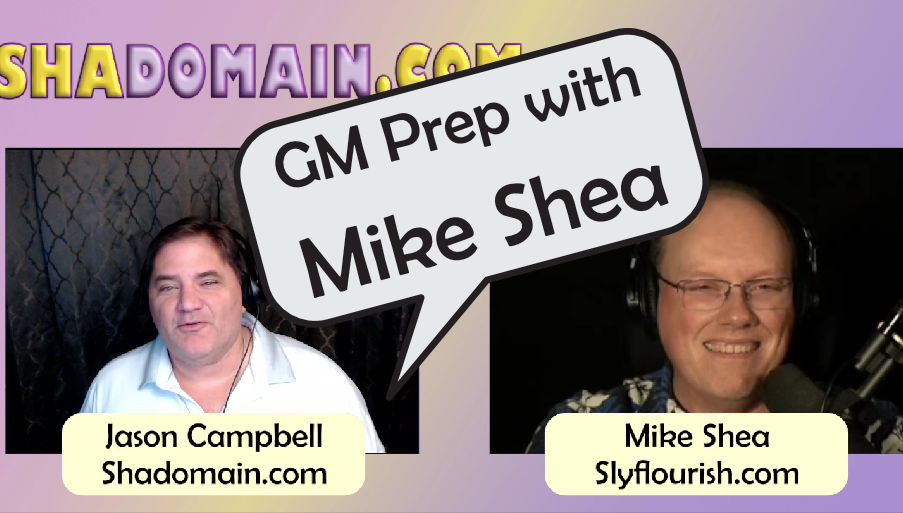
NOTE: the opinions expressed in interviews are those of the guests, not necessarily those of shadomain.com.
Today we talk to noted TTRPG author and caster/streamer Mike Shea, AKA Sly Flourish. Mike’s the author of the Sly Flourish’s Lazy Dungeonmaster/Game Master series of TTRPG books, aimed at helping GMs run better games. You can find his work at https://slyflourish.com/
You can see the video interview on our YouTube show when it premieres at 7:30 pm EDT on July 29 here:
https://youtu.be/5fQaj0TVd6o
Hi Mike, thanks for talking to us. Your upcoming book, Rise of the Lazy Gamemaster (in Kickstarter now) is the sixth book in the Lazy GM/DM series. If someone was new to the series, how would you describe its goals?
I wrote Rise of the Lazy Gamemaster to help gamemasters, new and experienced, have more fun with their games by preparing less. Rise focuses on eight steps for preparing your RPG “the lazy way” with a focus on the characters and the in-world components we can use to help us weave a story together with our players. It’s built to help GMs improvise as the actions of the characters change the direction of the story. The book focuses on four main areas:
- The eight steps, each expanded from the original Return of the Lazy Dungeon Master based on eight years of new experiences and feedback.
- Lazy campaign planning from the time you’re putting together a group to your final session in a long campaign.
- Adventure types — how to prepare them, how to run them, and how to avoid pitfalls.
- A Lazy GM’s Toolbox filled with proven tools, tips, and tricks to help GMs run their game.
Rise of the Lazy Gamemaster is a stand-alone book but sits well beside the other lazy GM books and every word is written to focus on the practical needs for GMs to prepare and run great games.
Rise of the Lazy Gamemaster is in a way a follow-up, but from the preview it seems like it’s something else as well. How do you see this book as different from Return of the Lazy Dungeon Master, and how do the books relate for a GM?
Rise of the Lazy Gamemaster focuses more on the eight steps and how you can use them, expand them, and refocus the for different stages in your campaign and different adventures that you run. Return of the Lazy Dungeon Master focuses on how you prep your game, how you run your game, and how you think about your game. I like to think that the two are different lenses on the same general topic. It’s definitely not just a rewrite. Both books cover the topic of GMing from separate angles.
Your books help gamemasters be more efficient in their prep by using your “8 steps” method. If a gamemaster preps more than that, but they love worldbuilding and extensive notes, how would you respond to them?
Rise of the Lazy Gamemaster actually includes a chapter on worldbuilding and there’s a fair bit of other talk about building out campaigns and the world in other sections as well. The big thing I’d say is to try to focus your energy and excitement for worldbuilding around the characters and how they can adventure in that world. Keep the characters as the focus of the campaign — they’re the characters that really matter. It may be fun to build ancient histories and deep global politics but your players want to watch their characters do fun things. What are you bringing to them?
Since my day job is as a project manager, I have to ask this one. How did your non-RPG career influence your efficient prep philosophy? Have you done a lot of project/process management and planning? Do you see the Lazy GM method as Agile? Waterfall? Or do you see no valuable relationship there?
About 20 years ago I got caught up in David Allen’s “Getting Things Done” and its practical nature for getting one’s life organized really sat well with me. I think some of the earliest concepts for focusing our prep around the next game we’re going to run and other principals tend to fall into that same level of practicality. A lot of self-help books focus on “big rocks” — the big things you need to focus on to have a great life without helping people actually manage what’s right in front of them. I think lazy GMing is a lot like that. You have a game tonight (I literally have one in less than an hour as I’m writing this) and you want to make that session as fun as it can be. No other session matters as much as the next one you’re going to run.
You’ve worked with a lot of great writers and editors, both in your own published works and in work you’ve done for other companies. How do you view collaboration? Do you think it’s essential, or a “nice to have”?
I have some folks I’ve worked with now for years that I see as partners in all that I do. Scott Fitzgerald Gray is a longtime editor for D&D materials going way back and I’m extremely lucky to have such a great relationship with him. He really gets what I’m trying to do and also pushes back to make sure what I’m putting out there is as good as it can be. My wife, Michelle, is my business partner in our little endeavor so we’re working together every day to make sure the Sly Flourish empire keeps moving forward. I’ve had wonderful luck bringing ideas to the Sly Flourish Patreon and getting feedback on early work which I think makes all my work better. So yeah, I think collaboration is essential.
You always have a ton going on. Now there’s the kickstarter, but you have a weekly Twitch show that you then edit for YouTube, a podcast, you write a blog and “on the side” you build a lot of tools for your Patreon and the TTRPG community. How do you manage to keep up with it all? Is there a personal “8 steps” just to manage your own schedule?
I have a solid to-do list that helps Michelle and I keep a “battle rhythm” going week to week. I know what I’m doing every day of the week to put things out. Sundays is the day I record shows, edit shows, and prep them for the rest of the week. Monday I’m working on new projects or otherwise moving things forward (lots of Kickstarter stuff going on these days!). Tuesdays I write a new article for later publication on the blog and website. Wednesdays is game night so it’s just prepping for that. Thursdays we prepare the following week’s articles, record a podcast for the patreon. Fridays is more creative work on new projects and other odds and ends. Saturdays I take off.
Four things that really help with a good to-do list:
- Being able to scheduling reoccurring to-do items that come up regularly.
- Being able to schedule to-do items for later.
- Ruthlessly cutting to-do items you know you’re never going to get to.
- Reviewing the whole set of to-do items weekly. Michelle and I review our entire to-do list every Monday going out literally two years (have to clean out the dryer vent in 2028).
What else haven’t we asked you that you’d like our readers and viewers to know?
My favorite book is Neuromancer by William Gibson. That book changed my life. Suddenly computers were cool.
Thanks, Mike!
Comments from the Community
We discussed GM Prep in our Discord server, here’s a cool post from Sir James
I use a modified version of the 8 Steps. I have a template I made for Obsidian with the main headings: Housekeeping, Recap, Strong Start, Scenes, Intrusion Ideas Along with a set of headings for Characters, Secrets and Clues, Locations, Loot, and Scratchpad Housekeeping is used for game-adjacent notes to bring up before the session starts. For example, one of the players was having an issue changing one of their stats on Foundry, and I fixed that between sessions, so I have that noted. Or as another example, I made a note that I wanted to discuss an upcoming Backerkit we might want to pitch in on. Recap is directly linked to the “Scenes” section of the previous session notes, so that it’s available as a quick reference to know what happened last time. In Strong Start I put one or two quick things to get the momentum of the game moving to the tone we want. A quick and punchy start to the first scene. Scenes is where I make the majority of my notes for what I expect to happen during a session, then edit and add to them as the session occurs, or more commonly, the next day. Intrusion Ideas is mainly for Cypher, but really just a list of obstructions, obstacles or funny things I could throw in the players’ path. Also important that I will put “fail forward” methods here so that I can intrude to keep momentum up. Those are the headings I use every session. The second set of headings isn’t used very frequently, but I do find it useful to have those in case I want to link something that didn’t have another place in the other headings. I try to keep my main session prep under 15 minutes for a typical 3 hour session. That includes brainstorming, notes, creature stat creation, etc. I don’t keep to that cap for extra stuff that isn’t necessary, like token and map creation, deep dives into character abilities, music selection, long-term story brainstorming, and whatever else. As those are optional, I only do those if I have extra time.
Sir James
RPG News: Here Comes GenCon!
We’re going to miss GenCon 2026 unfortunately, but here’s some things you might want to check out if you’ll be there.
Wizards of the Coast makes a return to GenCon in a big way, filling an entire six story building with weird and cool Dungeons & Dragons stuff. Check it out here.
https://www.dndbeyond.com/posts/2173-dungeons-dragons-at-gen-con-2026
Darrington Press will be there around the launch of the second book for Daggerheart, Hope and Fear. https://darringtonpress.com/gen-con-2026/
You can check out our Six-Gun Doomsday, our Weird West+Gothic Horror+Post Apoc ttrpg at the Indie Press Revolution booth along with other great games at Booth 449. A list of everything they will be selling is at https://www.indiepressrevolution.com/xcart/Gen-Con-2026.html
Check out booth 449 to visit our friends at Goosepoop Games.
Our friends at TTRPG kids have a bunch of events scheduled about TTRPGs for family and kids, check it out https://www.ttrpgkids.com/2026/07/07/ttrpgkids-talks-and-events-gen-con-2026/
About the Author