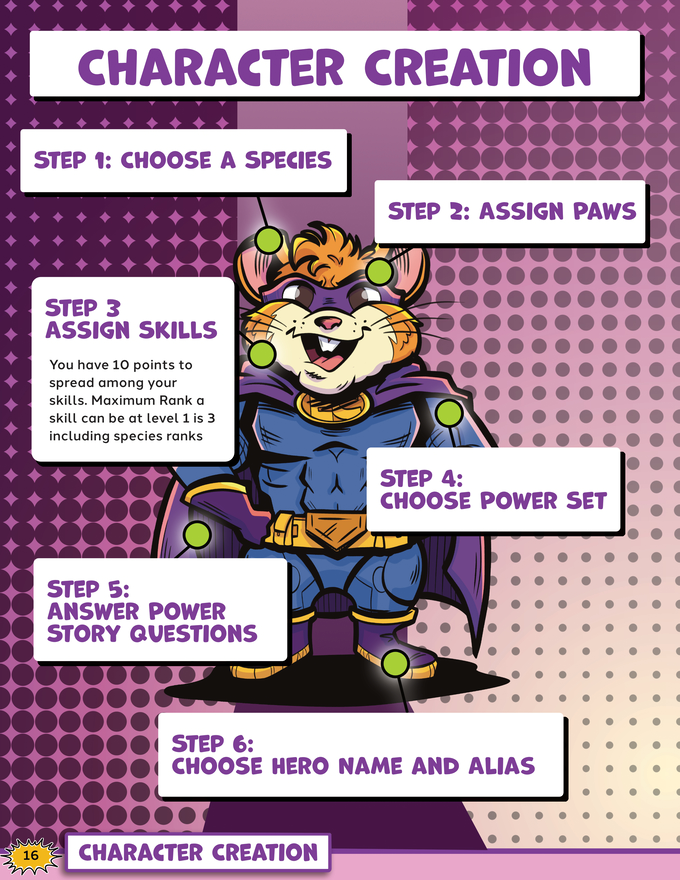

At PaxEast 2026 I ran a few games for Alexandria RPG Library. Sunday afternoon I ran a session ofKids on Bikes, one of my favorite TTRPGs. When I run Kids on Bikes I use the questions method to let the players build the “world” (usually a small town and/or school) with me. This is done by going around the table asking each player to contribute a fact about the town the characters live in, such as “What industry is our town known for”, or “What is the nickname of our school’s sports team?”. I always use the rule that any player can answer “I don’t know”, in case someone doesn’t feel comfortable improvising an answer at the moment.
In Kids On Bikes (and all the “Kids On…” games) the characters are young, but the game can be family friendly or dark and adult, it’s really up to the table.

Looking back on this session, although I think most players enjoyed it, I wouldn’t consider it entirely successful. I’ve run a lot of games at conventions and at local game stores, but things don’t always go as you’d like. I’ll examine how the game went and look for places where I might improve next time. Please feel free to add any advice and notes in the comments.
The Beginning
I had a full table of six players, most were familiar with TTRPGs but not with Kids On games. We walked through the basic rules, the players chose from pre-generated characters of the typical tropes (jock, popular kid, eccentric, etc) and we went through deciding the town was a middle class small town in the mid west, torn between cow farmers and sheep farmers. The characters were all teen-aged members of an animal rights group touring a farm. I explained the rules, but I find it best to explain only what’s needed to get started and explain further as we go. Most players are anxious to play and aren’t up for an hour of rules explanation.
FOR NEXT TIME: This beginning works well, but providing some more explanation of what the game expects from the players might have been useful. I think it would be better to mention that the players are building the story as a solution to a problem, and that their backgrounds, and other NPCs they meet can be helpful in solving the problem.
The Game’s Afoot
The “twist” in Kids on Bikes is the powered NPC. This is an NPC who can be an ally to the characters. The powered NPC has supernatural or science based abilities, similar to Eleven in Stranger Things, or E.T. in E.T. Each player is given a few aspects that can apply to the powered NPC, some motivations, some actual powers. A player can activate an aspect any time it fits the story, then that player controls the powered NPC until another player activates a different aspect.
The players encountered the powered NPC named Kevin — a teen who seeks to free the animals. Their most obvious power was the ability to teleport, similar to Nightcrawler in X-Men comics. The characters were sympathetic to Kevin’s ideas, but his plans ended up leading the story.
FOR NEXT TIME: Having Kevin’s situation drive the story is a natural way for the plot to evolve. I think that’s a good idea, but I let Kevin’s ideas for a solution drive the story. It would have been a better story if Kevin instead presented a problem to initiate the story, but the players present solutions to the problem.
The Story Evolves
The characters encountered Kevin, who presented his goals to help free the animals. The roleplaying went well, players acted to build the story. I realized that the story needed an up beat, or at least an action point, so a giant robot arrived, grabbing a cow in one claw. The characters tried a few things to help the cow, activating farm machinery to try to attack the robot and perhaps free the cow.
FOR NEXT TIME: Roleplaying went well, but I think the game could have been improved by asking for more dice roles. There was nothing wrong with the players’ actions, but requiring die rolls is a way to reassure the players that we are playing a game, not just writing a story together.
Trouble At the Table
An hour or so went by, and although the game generally was going well, I noticed one player seemed bored. They weren’t engaged with the story, mostly just looking down at their character sheet, or watch, etc. I failed a few times at trying to lead them back into the story. At one point later another player noticed the same thing and their character directly asked the other character for advice.
This player had told us they needed to leave a bit early, but ended up excusing themselves even earlier than they’d first indicated.
FOR NEXT TIME: I’m usually much better at involving players in the plot when they seem lost. I should have had some NPCs or items in the story act directly at this player’s character. In a one shot like this, the GM is often more empowered to add to characters. In a campaign you might hesitate to add something to a character’s backstory, but in this case, I could have improvised something such as “The farmer recognizes you. He runs over, calls you by name, attempts a bear hug, but then backs off hesitantly . Why does he do this?” The few times I did this, the player reacted positively, but then fell back into boredom soon after.
This isn’t always a GM’s fault, but it almost always feels that it is. It feels like you could have done more to help the player enjoy the game. Truthfully I have no way of knowing if they were bored with the way I ran the game, or they just didn’t enjoy Kids on Bikes, or maybe they were just tired at the end of a 4 day game convention.
Conclusion
As a forever GM (by choice), I can’t help feeling that there was more I could do, for the one bored player. That may not have made them enjoy the game, but that’s always how it’s going to feel. The trick is to not feel that the game was a failure. Sessions like this don’t mean that you’re a failure. I had 5 other players who had fun. But there’s always room to improve, and that’s the moral here: You can always do better next time. My goal is not to “be great”, but just to be a little better than I was the last session.
FOR NEXT TIME: Running this game (at least with the way I use the setup) requires the GM to improvise a lot. I really like that, it’s a fun challenge. The next time I’ll take 5 minutes in between major scenes to think back on the way the story is evolving and get a couple of simple ideas for ways to push it forward. Running games at a con can feel that time is always ticking, and that’s true. But if you take 5 minutes, your players won’t mind, they can get a drink or look at shiny new dice, and they’ll be happier when the story gets stronger.
What do you think? What else could I have done to improve the session?
Crowdfunding: Simulacrum
“Simulacrum is a thrilling, action-packed 250-page cyberpunk espionage RPG from The Yellow Hand, publishers of the robot RPG Sentience.”
Back it here.
About the Author