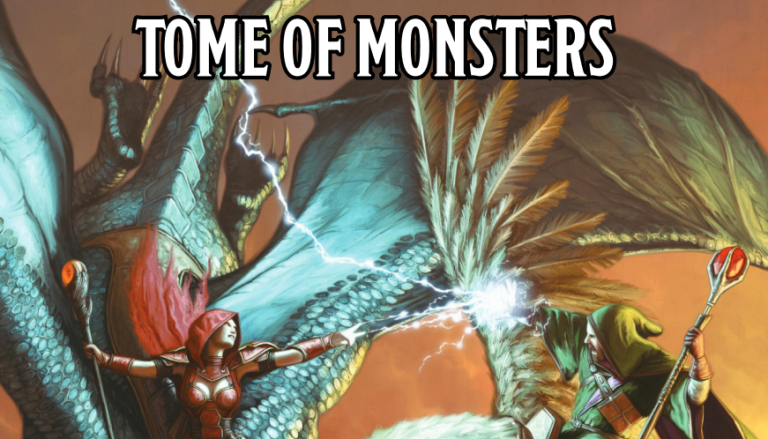

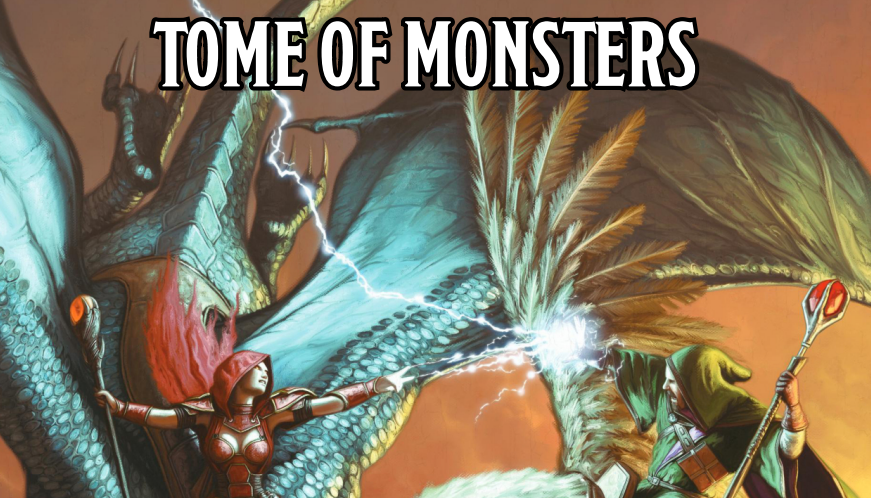
Tome of Monsters is a bestiary of creatures for 5e based games, created and published in 2026 by Luigi Caterino (aka DM Slash). You can get the book in PDF or print on demand at Drive-Thru RPG. There are 300 monsters across 379 pages with many full color illustrations. The monsters range from CR 0 to CR 30 across many categories such as Aberrations, Beasts, Fiends, Elementals, etc.
We were given a PDF copy for the purposes of this Read Through. The PDF is hyperlinked from the Table of Contents, but does not have bookmarks. The design of the book uses the colors and typography familiar to Dungeons & Dragons fans, including using a copy of the Modesto typeface on the cover, which is similar to the custom version of Modesto licensed by Wizards of the Coast for their covers. For this Read Through we reviewed the contents of the book, but have not play-tested the stat blocks.
Introduction
The book begins with several pages on how to use these monsters, including useful suggestions about building encounters and how characters might learn about these creatures.
The monsters are arranged by types, not alphabetically by name. This helps when reading through the book, but could be problematic when using these creatures in a game. For instance, if you’re using the Mothmen and need to reference the stat block in a game session, you need to know that the Mothman is a Humanoid, as you need to flip to the “Humanoid” secion, not the “M” section. This is workable though, since the Table of Contents is hyperlinked, you just need to start there when looking for a particular stat block. Besides the Table of Contents there’s a table listing monsters by Challenge rating, which is hyperlinked to each stat block, but doesn’t list the page numbers of each monster.
Types of Monsters
Each monster type section begins with a general description that’s useful as background information for creatures you might add to your game. Each type description has a table breaking down each monster of that type by CR (these tables are also hyperlinked).
The monster stat blocks are very well done, borrowing the well known formats from Dungeons & Dragons books which make them easy to scan to anyone familiar with D&D. Each monster begins with a description of the creature including suggestions on locations they might be found and ways they could impact an encounter.
This book offers specialized versions of many monsters which helps to bring interest to adventures. For Mechanical Gremlins (Constructs), for instance, there’s a stat block for a standard Mechanical Gremlin and four additional versions which have differing abilities. That makes each creature more interesting as you can build a small group with leaders and specialists, but it also helps at higher tiers where you might need a higher CR version of a creature to challenge your characters.
Appendix A features many random encounter tables using monsters from this book. The introduction to this appendix includes helpful advice on making the best use of these random encounter tables. There are random tables for many different environments, and each environment has a table for each tier of play (when there are enough entries in a tier to require a table). This is a great idea for using the tables during a session. Unfortunately these tables list the name and CR of a monster, but not the monster’s type. Since the book doesn’t list the monsters in alphabetical order, that will likely add an extra step when using the tables in a session. For example, in the Sacred Sites and Celestial Realms tier 2 table, you could get the result of an Asura. If you don’t know that an Asura is a Celestial, you’d have to look it up by CR to find the page that the Asura stat block is on.
After the encounter tables there’s a section featuring Monstrous Adventure Hooks. For each tier of play there are paragraphs describing different adventures that a DM could flesh out: 10 at 1st and 2nd tier, 8 at 3rd tier, and 4 at 4th tier. These are really great for DM prep when you’ve got a bit of writer’s block.
My Favorite Monster
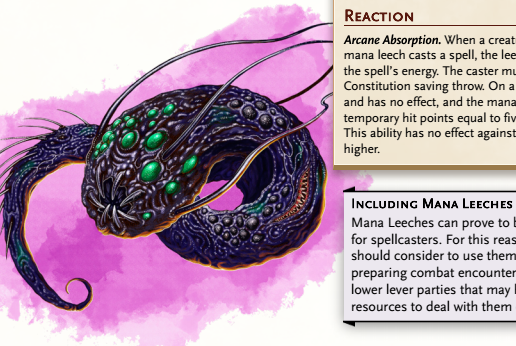
It’s impossible to review all the monsters in a bestiary this big, so I’ll instead highlight my favorite monster. It’s equally difficult to choose one as my favorite, but if I have to choose one, it’s Mana Leeches. They are tiny aberrations that are instinctively drawn to spell casters because the Mana Leech feeds on magic. It has cool background descriptions, but my favorite part is the action Leech Bite. On a successful attack on a spell caster the Mana Leech can use its Leech Bite to eat (steal) a spell slot (level 1-4, randomly determined) from the victim (if they fail a Constitution saving throw.) I love when unique attacks have unexpected consequences. It keeps the game fresh for jaded players.
Review of a Random Monster
I used the random encounter tables at the back to choose another monster to highlight. I randomly chose Mountains and Highlands as the environment, and tier 3 (levels 11-15), which yields 15 possible monsters, although the tables use a d100 roll, so that some monsters are more likely to appear than others. The result was
1 Cyclops Ravager (CR 10); 1 Cyclops (CR 6). Two giants dismantle a toll fortress that obstructs their traditional route.
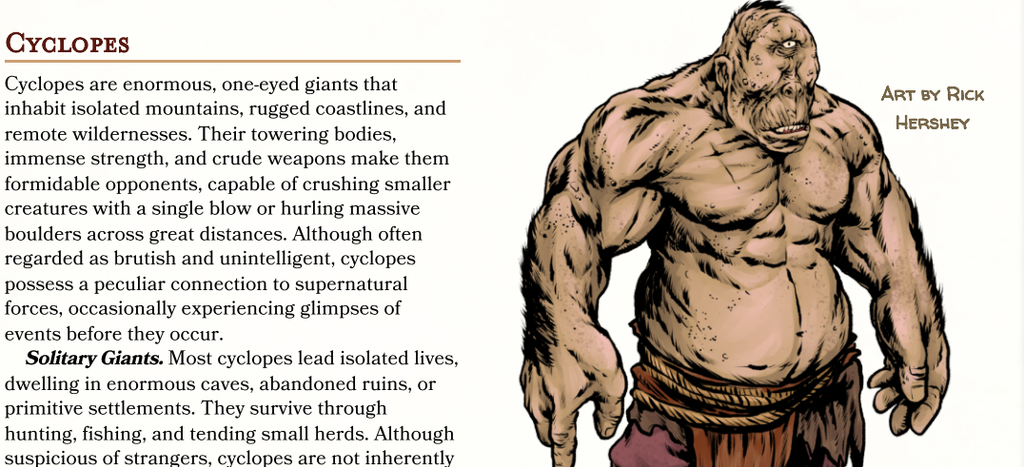
For Cyclopes there’s a stat block for a standard Cyclops and three additional versions which have differing abilities. The background details for Cyclopes describe them as brutish one-eyed Giants who have a connection to the supernatural. There’s legends that Cyclopes descend from ancient giant civilizations from ages past, which gives you some potential plot threads for your campaign.
The activity that the Cyclopes are dismantling a toll booth is cool, and gives the DM some of the “why are they here?” that’s often missing in random encounters.
Cyclops (CR 6)
The standard Cyclops is a Huge Chaotic Neutral giant which makes two attacks with a stone club or rocks. If the Cyclops hits with its stone club, a Huge or smaller creature is knocked prone. Personally I’d prefer if there was a saving throw to avoid being knocked prone, but since the prone condition is not impactful in most 5e combats, that is a very minor thing.
Cyclops Ravager (CR 10)
The Cyclops Ravager is a Huge Chaotic Neutral giant which makes three stone club attacks or two rock attacks. In the Cyclops Ravager stat block the stone club attack does not list the knocked prone effect mentioned above. The Cyclops Ravager also has the Groundbreaker attack: the Cyclops Ravager strikes the ground creating a shockwave which can cause 35 hp damage and knock characters prone if they fail a DC 20 Dexterity saving throw. This attack recharges on a 5-6. It also can do siege damage and use a Rampaging Charge: If the cyclops ravager moves at least 20 feet straight toward a creature and hits it with a club attack on the same turn, the attack deals an extra 10 damage and knock a victim prone or push them away from the ravager if the character fails a saving throw. The Cyclops Ravager is a cool addition, which could be used as a chieftain’s weapon when battling a tribe of Cyclopes.
In a careful analysis you might call out some inconsistencies in these stat blocks, but these giants have a connection to the supernatural, so I look at these things as mysteries that make encounters interesting.
Conclusion
The Tome of Monsters is a well done and useful supplement for any 5e game master. There are a few layout details that could make the book more useful when you need monsters in a game session. But the most important test of any bestiary is the quality of the monsters. These are well written with inspiring illustrations for most entries. It’s a book that you’ll enjoy flipping through, and will likely give you ideas for your next adventures.
About the Author