
By Jason Campbell
Today we’re doing a read-through of the Daggerheart core rulebook from Darrington Press. We recently talked through the book in two episodes of the TTRPG Book Club, on the DM Tales YouTube channel.
Chapters 1 & 2 with @shadomain, @dmtales, and @paravox
Chapters 3-5 with @shadomain, @dmtales, Clavin and @tezrak
Today we’ll discuss the details.
The Book Itself
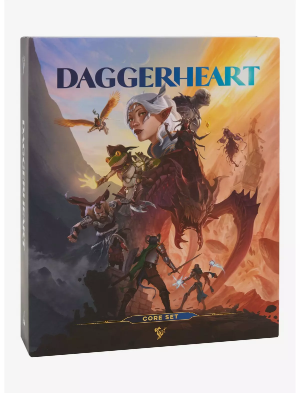
The Daggerheart core rulebook is beautiful. The book is a 366 glossy page hardcover with 2 bookmark ribbons.The full color illustrations inside are in a painterly style fitting the heroic fantasy themes of the genre. The typefaces used for headlines and subheads are modern sans-serifs which is strikingly different from other fantasy TTRPGs that fall back on Renaissance period tropes. The body text is a bit difficult to read for readers with slightly compromised sight. This could have been improved with a larger point size, or a heavier style to increase the contrast. The edges are colored so that each chapter has its own color, making it easier to find what you’re looking for.
Introduction and Chapter One: Character Options
The book begins with a short introduction, detailing role-playing games for new players.
Chapter One contains options for player characters. The available layer character classes are: Bard, Druid, Guardian, Ranger, Rogue, Seraph, Sorcerer, Warrior and Wizard. Most of these are familiar, but Guardian has aspects of classes like Paladin, and Seraph has aspects of classes like Cleric in other games. Each class has a Domain associated with it (such as Arcana, or Valor). Each character has cards from one of these domains which describe powers. Each class has two subclasses which the player chooses at character creation. There are six character traits which vary a bit from D&D and Pathfinder norms; Agility, Strength, Finesse, Instinct, Presence and Knowledge.
Each character has an Evasion score which is used similar to Armor Class in d20 games.
Each character chooses an Ancestry (species); Clank (a construct), Drakona (dragon ancestry), Dwarf, Elf, Faerie, Faun, Firbolg, Fungril (a mushroom person), Galapa (a turtle person), Giant, Goblin, Halfling, Human, Infirnis (demonic), Katari (a cat person), Orc, Ribbet (a frog person), Simiah (an ape person). Each Ancestry gives a couple of features.
Each player chooses a Community their character came from, so no matter the ancestry a character could be a highborne, an underground borne, seaborne, etc.
Chapter Two: Playing the Game
This chapter gives advice for players new to this game, and provides many details for weapons, damage and such. This chapter will be used as a reference while playing the game more often than most chapters.
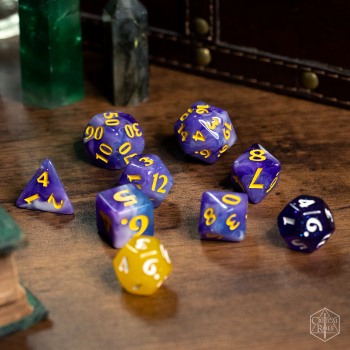
This explains the main mechanic of the game: Hope and Fear. When attempting a task a player rolls two d12, one representing Hope and the other Fear. The player is attempting to meet or exceed a DC established by the GM. If they meet or exceed the DC they succeed at the task, otherwise they fail. Regardless of success or failure, if the Fear die is higher than the Hope die, the GM gets a Fear token, if not, the player receives a Hope token.
Daggerheart uses what might be called asymmetrical mechanics: Players roll 2d12 to attempt a task, while NPCs roll 1d20 to attempt a task. Taking damage is also different for NPCs and Characters.
Chapter Three: Running an Adventure
This chapter begins the GM advice section.
Chapter Three begins with GM Principles and GM Best Practices. GM Principles includes advice such as make every roll important and ask questions and incorporate the answers. This list seems most valuable to GMs coming from other traditional games such as D&D or Pathfinder. The advice is trying to shift the traditional DM mindset a bit into involving the players’ input.
The GM Best Practices include; gain the players’ trust and help the players use the game. This list is geared towards helping newer GMs manage a game by keeping the story moving forward.
The chapter goes on to explain the core mechanics of the game and how a GM can use those to build a story.
One aspect of Daggerheart that’s different from most d20 games is the flow of combat. The game does not use an initiative system to alternate combat turns. Players take actions in combat and whatever order makes sense for the flow of the story. If a player fails, the GM can have an Adversary take an action, or they can spend Fear tokens to have an Adversary act.
Chapter Four: Adversaries
This chapter contains all the “bad guys”, here called Adversaries. There’s a Battle Guide system with formulae for creating level battles (or uneven battles if desired). Each Adversary stat block takes up less than a quarter of a page, so there’s many creatures packed into this chapter.
At the end of the chapter are stat blocks for Environmental Adversaries, from smaller scenes such as a Raging River to a Tavern or Haunted Village. There are suggestions showing possible inciting incidents, and many could be expended for a complete adventure.
Chapter Five: Campaign Frames
This chapter contains six campaign “frames” — mini settings that can be built into a complete long term campaign. The chapter contains:
- Witherwild – an invading nation attacks a forest deity.
- Five Banners Burning – wars between nations and factions.
- Beast Feast – explore caverns filled with monsters.
- Age of Umbra – protect people in a dying world.
- Motherboard – found tech from ancient civilizations replaces magic, then a virus appears.
- Colossus of the Drylands – gunslingers versus monsters from beneath the earth.
Conclusion
Daggerheart is a well designed game that many enjoy since its release in May of 2025. The trade of Fear versus Hope tokens is designed to help build a story, not just play a mini game of tactical combat. It’s often labelled a “narrative first” game, although the game isn’t simple. It will take time to fully understand the way the mechanics interact, as it can be as complex as many d20 fantasy games.
Let us know what you think? How are your Daggerheart games going?
About the Author