
By Jason Campbell
Note: this is an update and expansion to an article first published in May 2023.
Humor is a big part of many ttrpg sessions, but should it be a part of the written rules? That’s a big question. First we’ll take a look at some roleplaying games that incorporate humor in the rules include the recent Monty Python’s Cocurricular Mediaeval Reenactment Programme.
TOON: The Early Days
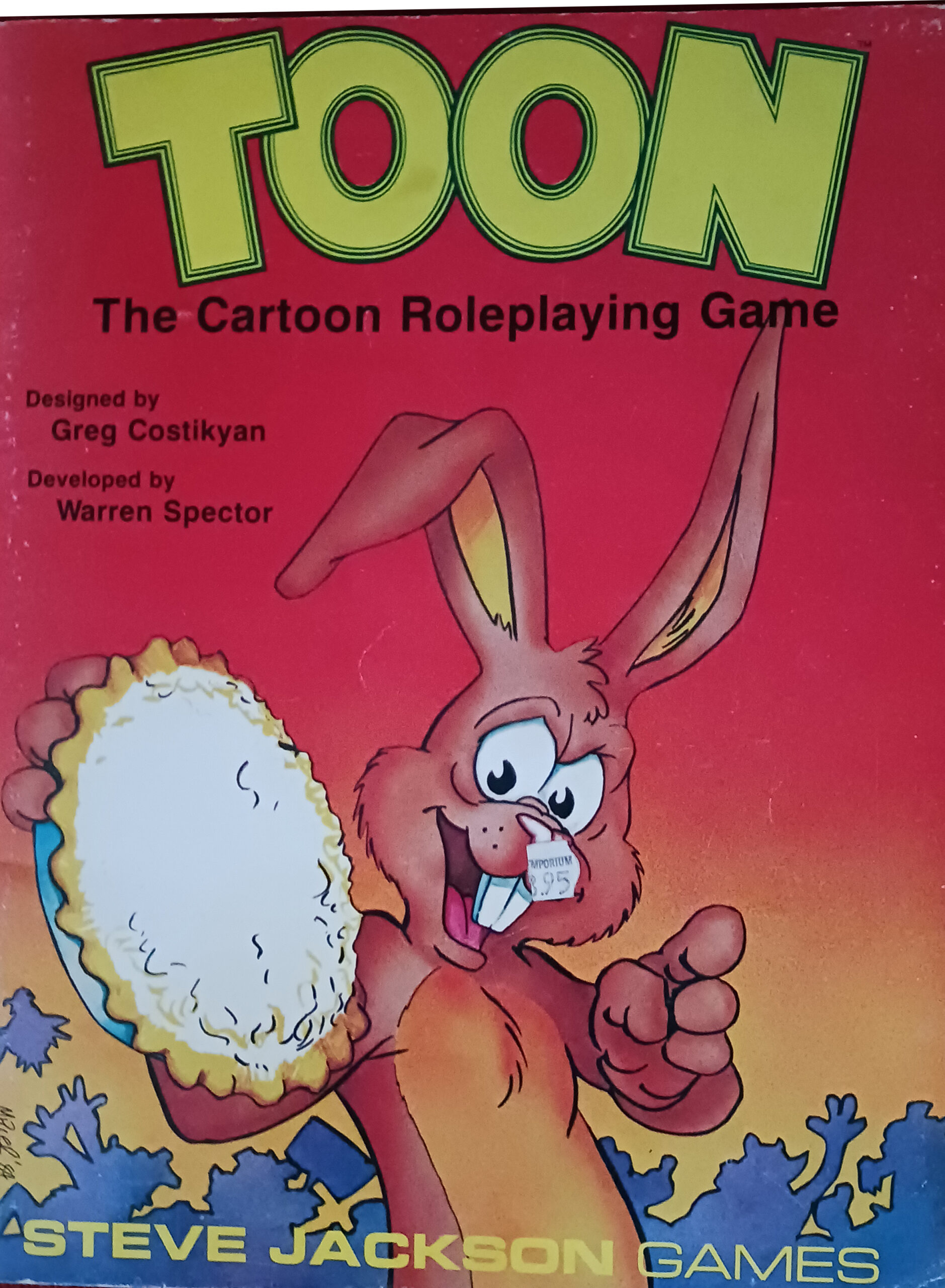
There have been many game systems built around humor. One of the first and best is TOON, designed by Greg Costikyan and developed by Warren Spector and first published by Steve Jackson Games in 1984. This game is
inspired by classic cartoons such as the Warner Brothers cartoons starring Bugs Bunny and Daffy Duck. In TOON you create one of these characters and play out a short scenario, hoping to incite laughter in the other players. Your character can’t be killed; if they lose health they “fall down” for a certain amount of real game time.
And Even Sillier – Bullwinkle and Rocky Role-Playing Party Game
Building on this sort of sentiment was the Bullwinkle and Rocky Role-Playing Party Game. This game was even sillier and meant to be played at a party (perhaps while imbibing?) and the game even included plastic hand puppets of the main characters.
Toon is very well known to those who gamed in the 80s, but I’ve found that more people know about it than actually played it very often. Bullwinkle and Rocky is a trivia question, I’ve never found anyone else who had that game. These games might be labeled as “seemed like a good idea at the time.” These games just weren’t commercially successful when compared to “standard” ttrpgs.
TOON Into the Future
This week Steve Jackson Games launched a campaign on Backerkit to publish a second edition of Toon. This version is Designed by Greg Costikyan, developed by Warren Spector, and revised by Steve Jackson.
And Now For Something Completely Different – Monty Python’s Cocurricular Mediaeval Reenactment Programme
Recently Exalted Funeral released Monty Python’s Cocurricular Mediaeval Reenactment Programme, an officially licensed game. It consists of a core book featuring the game rules and and ready-to-run adventures. There is also a minigame that involves dice catapults and farm animals, called Fetchez la Vache. The game has received a lot of positive reviews and has been popular when played at game conventions.
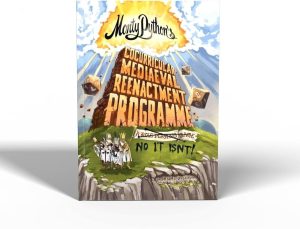
Monty Python is a game which juggles swingy chaos. The GM plays a specific persona with their own likes and dislikes, the players attributes can change their dice at wild moments, and rolling too high get you into trouble. There’s drunks, retainers, and the possibility of a giant foot squishing a character to be no more. Playing it is an hysterical time where insulting the Head of Light Entertainment can lead to your character being shot down by a group of over-zealous Bolsheviks.
Wes Allen (DM Tales)
The rules forMonty Python’s Cocurricular Mediaeval Reenactment Programme give maybe the most important advice for playing in a humorous roleplaying game
Don’t try to be funny. Play the characters absolutely straight and let them do the first thing that pops into their head.
Monty Python’s Cocurricular Mediaeval Reenactment Programme
Conclusion
I find that most game sessions include a lot of humor. This is natural as the groups are often made up of friends and joking and laughing happens with people whose company you enjoy. Many of the most popular actual play ttrpg shows such as Critical Role, Dimension 20 and Glass Cannon contain a lot of joking and laughing, some of these moments become the most popular. Yet all these shows have a serious game scenario at their core and the jokes are occasional moments within the larger game session.
So if players actually enjoy moments of humor in their games, why the opposition to games built around humor? I wonder this as I write a lot of single session one-shot adventures with humor at the core (see my adventures “Hint” and “Three Hour Tour to the Island of the Lost”.) I find that when I post these games to “looking for games” channels online, they rarely fill, but if I post a standard fantasy or sci-fi adventure it fills quickly. I asked my friend Qedhup about humor in ttrpgs as he’s written some more light hearted fare;
“When it comes to humour in RPG’s there are few things you need to remember. The first is Contrast. If you draw with white crayon on white paper you won’t see much. The same goes for Humour. If there is too much of it, and nothing serious or mundane as a contrast, then it becomes tiring. Secondly, know your audience and aim for it. You can’t please everyone, and you can’t make everyone laugh. So aim for who you want to laugh the most and don’t worry about everyone else. Lastly, laughter is the mind’s ability to temporarily go insane to the little horrors of reality. Think of the vast majority of things that are funny? Someone getting hurt, embarrassed, inconvenienced, an unexpected shock, etc. That doesn’t mean take it too far, but humour is often a commentary on the tough aspects of life and the ridiculous ways that we handle it.”
Qedhup
I have two theories about this phenomenon. First, I think that when humor is written into the game rules or adventure premise, players feel like it’s expected, even required. They feel as if they’re being told when to be funny and when to laugh. In this way players feel like joking around the table in a “serious” game is more natural than games where humor is expected.
Second, I think a lot of players feel that humor is best in small doses. The jokes and laughs sprinkled throughout a serious game may have more impact because they are the exception to the rule. If humor is written into the game they feel that it actually becomes less funny as the jokes are constant.
What do you think about humor in games? Let us know in the comments below
Thanks to Qedhup for his contributions, he can be found here: https://linktr.ee/qedhup
Thanks to Wes Allen of DM Tales, he can be found here: https://dmtales.com/
About the Author


I love humor in my games and do my best to add some when I can where it fits.
Of course that’s nowhere near as much as what comes about naturally.
I firmly believe that games – for me and my friends ay least -are best treated as an excuse to get together, joke, chat and debrief about our days – if we happen to roll some dice and attack some monsters, then that’s icing on a nice evening.
We are all tired adults with dayjobs. Two of my playgroups are entirely medical professionals, who have a lot of stress and long busy days. So if I can help them shed that for a few hours and get a few laughs in, I think I’ve done my job.