NOTE: the opinions expressed in interviews are those of the guests, not necessarily those of shadomain.com.
Today we talk to noted TTRPG author Keith Ammann.
You can find Keith at:
@themonstersknow.com (Bluesky)
@Ke*********@**ce.camp (Mastodon)
Let’s get to the questions!
Your latest book, Making Enemies, has received a lot of accolades from people all over the TTRPG community. If anyone isn’t familiar with it, could you describe the book, and what inspired you to write it?
In February 2022, when I was doing an interview on the podcast Mastering Dungeons, Teos Abadía and Shawn Merwin characterized me as a “designer of monsters,” and I protested that I didn’t think of myself that way—I thought of myself as a Dungeon Master who occasionally designed monsters, but not frequently or as a core aspect of my work. I said I saw myself as more of a critic or an exegete than a designer. But they maintained that they’d enjoy reading a book on my thoughts about monster design, so when I was casting about for a topic to follow up How to Defend Your Lair, that’s what I settled on.
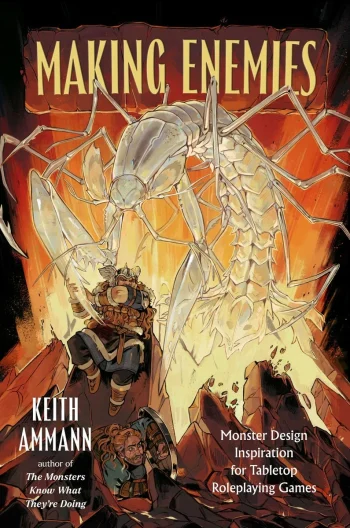
Making Enemies is a collection of thoughts on designing monsters, ranging from the mechanical basics to more advanced mechanics such as tactical combinations and phase changes to deeper concepts such as what monsters represent metaphorically. It’s a toolkit for DMs who want to delve into design, one that lets them pick and choose which aspects of monster design they want to incorporate. And it includes conversations with other designers that provide a window into their own thought processes, along with sample monsters designed in several different systems.
Although the ideas in Making Enemies would be valuable in any game system, you’ve specifically written about designing monsters for five systems (D&D 5e, Pathfinder, Shadowdark, Cypher System and Call of Cthulhu). How complicated was it to analyze and write about creating monsters in each of these systems? Was any one of them particularly difficult?
Dungeons & Dragons and Cypher were the easiest for me, because I was very familiar with those two systems already and had good intuition about what works and what doesn’t. Pathfinder kicked my butt. It’s an extremely crunchy system in which everything has to be written just so. The remastered GM Core includes outstanding instructions for ballparking the numbers, but what it doesn’t tell you is that you still need to go in and make sure those numbers are derivable from a monster’s attributes and proficiency bonuses. I called in the help of an editor with Pathfinder experience to make sure I got all that stuff right. Call of Cthulhu was challenging, too, but not as challenging as Pathfinder, because encounter balance isn’t as great a concern in CoC. Shadowdark is a nice, intuitive system; the greatest challenge I had with that was forcing myself to pare everything down to the minimum necessary to get my ideas across.
Right now, I’m working on a supplement to Making Enemies for Daggerheart. I’d put it alongside Cypher in terms of difficulty. I’m still less familiar with Daggerheart than I am with Cypher, but I’m getting the hang of it quickly.
In between the monster design chapters in Making Enemies you’ve got some great interviews with creators in all aspects of the TTRPG industry. How did that come about? Was there any interview answer that surprised you?
With each of my books, I’m trying to raise my game a bit and to offer readers something they’re not going to get from anyone else. In this case, I saw an opportunity to leverage my background in journalism. Talking with these other monster designers was a chance for me to educate myself, but part of The Monsters Know What They’re Doing has always been sharing my own self-education with my readers. All those conversations were great fun.
The biggest surprise was when James Mendez Hodes informed me that bat researchers don’t use the categories “megabats” and “microbats” anymore, after I just learned those terms from reading Amara and the Bats to my kid. Now I have to contact the author and ask her to put out a revised edition.
You’re probably most well known for your books The Monsters Know What They’re Doing, MOAR! Monsters Know What They’re Doing and How to Defend Your Lair. Some readers might not realize that the ideas for those books came from your blog https://www.themonstersknow.com/. How did the blog start, and when did you know it would make great books? Do you have future plans for the series?
I started the blog because of two things: I was unemployed and wanted to get back into writing as a regular practice after having been out of the journalism and publishing fields for more than a decade, and I was dissatisfied with how I’d run the first couple of encounters in the D&D Starter Set adventure Lost Mine of Phandelver and was conducting an autopsy on what had been missing from them. I decided that the process of going line by line through monster stat blocks to try to understand what those stat blocks were telling us about monsters’ natures and combat styles was something that other DMs might be interested in, and I decided to make that the subject of my (then-)daily writing. At the time I didn’t intend for it to become an online reference database, but it grew into that, and I rolled with it.
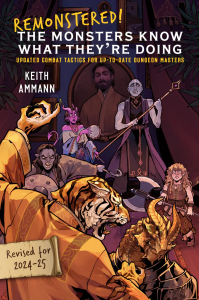
Of course, the 2024 rules revision to D&D 5E changed some of the rules and many of the stat blocks, so the battle plans in the original The Monsters Know What They’re Doing no longer apply. But I knew that was going to happen and started work on a revised edition as soon as the 2025 Monster Manual dropped. Remonstered! The Monsters Know What They’re Doing is due out on Oct. 6, 2026. Beyond that, I’m not sure. There have been so many changes to D&D and to the tabletop roleplaying game landscape in general since 2023 that it’s hard for me to know what direction I ought to go in next. Defensible space (How to Defend Your Lair) has long been a niche interest of mine—as an undergrad, I minored in sociology, and urban design was one of the topics I studied—and Making Enemies was a natural offshoot of my other work. But some of the other things I’m especially interested in, such as geographical approaches to worldbuilding, are already well-trodden ground, and I’m not sure what I could add to the conversation.
You’ve also written books about combat tactics for players (Live to Tell the Tale: Combat Tactics for Player Characters). Do you prefer running games as a GM or running a player character? Was it a big change to write about tactics as a character instead of as a monster?
It’s less a matter of preference and more a matter of opportunity. If there’s a game I want to play or an adventure I want to experience, the easiest way to do it is to say, “I’ll run it.” I love playing, I love creating characters and getting into their heads, but someone’s got to run the game, and that’s usually me. There’s also the aspect of being choosy about my gaming experience, wanting to know it’s going to be good. I was a picky eater growing up, and I figured out that the surest way to have something on the table I’d want to eat was to do my own cooking, so I learned to cook. It’s the same with TTRPGs, isn’t it? The surest way to have the kind of game experience you’re going to enjoy is to be the game master. But I’d love to be able to hand the reins off once in a while.
As for player tactics vs. monster tactics, aside from there being more different kinds of synergy among player character abilities vs. the kinds of monsters you’ll generally see grouped together, it’s all pretty much the same, because it’s all governed by the rules of the game, which function as the natural laws of the game world. I’ve always thought of the monsters as the DM’s characters anyway—the opportunity to roleplay the wants and needs and abilities of a creature whose interests are at odds with the PCs’. So I was doing a sort of “tactical method acting” with the monsters already, and it wasn’t a great leap to switch from the monsters’ point of view to the PCs’.
How did you get into playing TTRPGs? Do you also play video, card and board games, and which came first?
I tell that story at the start of The Monsters Know: I was 10, I read about D&D in Games magazine, I asked my mom to get it for me—”it” at the time was the Holmes “blue box” set—and then we sat down and couldn’t figure out what to do with it. I was 17 before I found a group of friends who had figured out what to do with it, and we played well through our college years before we all went our separate ways.
As for “video, card and board games”: Yes, all three, though with different emphases at different times. And when I say “video games” what I really mean is “computer games,” because I’ve never owned a video game console. I’ve always played on computers, starting on an Apple IIe when I was 13 or 14. I played everything I could get my hands on, but Lode Runner, Fooblitzky, Odyssey Apventure, RobotWar, Lords of Conquest and Ultima IV stand out—especially Ultima IV, which I’d go so far as to call formative. Even before that, I played board games and card games—I learned the rules of chess when I was 8, although I didn’t get any good at it until I was almost 40, but there were always various other board games in the house. I played the heck out of Mastermind, every kind of Mastermind I could get my hands on: Deluxe Mastermind, Word Mastermind, Grand Mastermind. I joined my high school’s strategy gaming club, which introduced me to Diplomacy. I played Uno and Mille Bornes at summer camp. My dad taught me to play cassino, which hardly anyone has heard of, and it blew my mind years later when I was introduced to Keith Baker’s game Illimat and I realized it was built on a cassino chassis. In college, my friends and I played hearts for hours, along with an Uno variant a couple of my townie friends had devised that they called Hot Death Uno, and our Trivial Pursuit team ran away with the dorm championship. Then, in the mid-’90s, I got on the German game train and spent a ton of time playing those for about a decade, both face-to-face and on a website called Brettspielwelt, and around the same time I learned to play go. I never stopped playing computer games in all that time, but they moved back to the forefront from the mid-2000s to the mid-2010s. And also at that time I decided once and for all to acquire some competence at chess, and I directed tournaments for a while. So I guess what I’m saying is, games of all kinds have always been a huge part of my life.
Your books come from a wonderfully analytical perspective. Is this something you’ve always been interested in? Do you bring this point of view to other parts of your life?
I can’t not bring this point of view to everything. For better or worse, it’s how my brain works.
What haven’t we asked you that you’d like our readers to know about?
Who produces all the amazing art without which my books would be drab shadows of themselves. That would be cover illustrator Lio Pressland; interior illustrator Jen C. Marshall, to whom I happen to be blissfully married; and mapmakers Dungeon Baker, Chloe the Cartographer and Fernando Salvaterra.
Thanks, Keith!
If you’d like to do a Q&A here, please send an email to sh**********@***il.com. We’d love to hear anyone’s opinion from new players to grizzled veterans.
About the Author