

grognardia.blogspot.com
By Jason Campbell
For the past few decades if you heard a friend was running D&D you could be pretty certain what they meant. Wizards of the Coast (and TSR before that) has published a single version of the D&D rules at a time (although 3e and 3.5e would have been available in stores simultaneously, as would 4e and the 4e essentials line). But let’s look back, dear readers, at a very different time: 1983
Advanced Dungeons & Dragons
The AD&D game (often referred to now as first edition) began with the publication of the Monster Manual in 1977, the first rulebook released as a hardcover. The Players Handbook was published in 1978 and the Dungeon Masters Guide in 1979 to complete the core rulebook set.
In 1983 this was the dominant version of D&D and was arguably the most popular version at this time.
BECMI Dungeons & Dragons
BECMI D&D is a modern abbreviation for the line of D&D games known as Basic, Expert, Companion, Master and Immortals, published beginning in 1983 by TSR. Note that this was the third time TSR published a game called “Basic” and the second time they had a game called “Expert”.
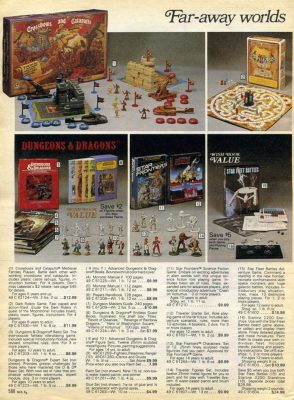
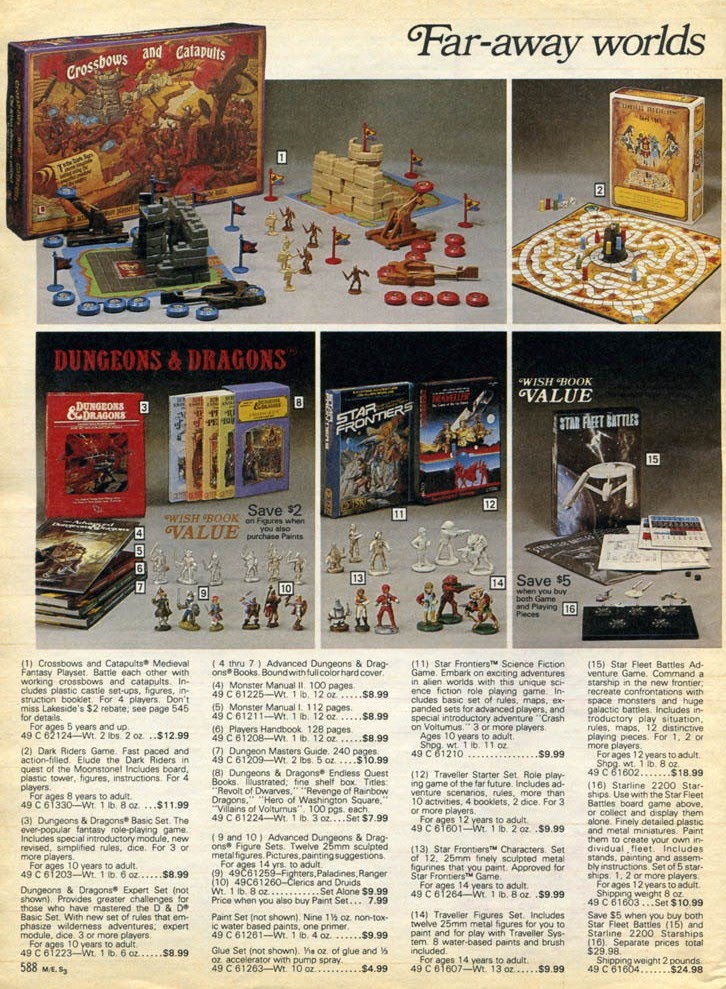
This version was released in 1983 so it would have been brand new to the shelves and garnering a lot of interest. Frank Mentzner (lead editor and writer for this version) said that this version was created in part due to a deal with the Sears catalog. That explains (sort of) why TSR released new Basic and Expert Rules only two years after the release of the previous Basic and Expert books.
B/X Dungeons & Dragons
The Basic D&D book written by Tom Moldvay and the Expert set written by Dave “Zeb” Cook and Stephen Marsh were released in 1981. These books were an attempt to be an easier point of entry to D&D, compared to AD&D which was often viewed as very complex. The Players Handbook was a 121 page hardcover and the Dungeon Masters Guide was 236 pages, where the 1981 Basic book was a 64 page staple bound paperback.
In 1983 and for several years afterwards these books would have been available at toy and hobby stores, even though the BECMI books were also available. This would have created confusion to players new to the game, but at least they had options, and all of them were bringing money to TSR.
But Wait – There’s More!
In the 1983 Sears catalog (aka the “Wish Book”) you would only see the BECMI and the AD&D books. But at game, toy and hobby stores you would have a good chance of finding the B/X versions too. But maybe even more, because in 1983 stores often kept books on the shelf until they sold.
The original D&D game (often referred to now as OD&D or 0D&D [with a zero]) was released in a series of 7 (or 8, depending on if you include “Swords & Spells”) staple bound digest size books beginning in 1974. By 1983 TSR had long since stopped publishing the original booklets, but if you were lucky you could still find some of these booklets in game stores.
The original D&D books were not well organized and could be difficult to interpret, particularly for players new to the game trying to play by reading the books. Professor Eric J. Holmes wrote a more organized book (it’s said he volunteered to do this to help new players) published in 1977 as the first Basic Dungeons & Dragons. This was a 46 page staple bound paperback book and was sold in a box set. The book did more than reorganize the rules – it modified some rules. By 1983 TSR had stopped publishing the 1977 Basic D&D set but as with the OD&D books, this was still available in some game and hobby shops.
Conclusion
In 1983, walking into a game, toy or hobby store, you could see anywhere from 2-5 different versions of Dungeons & Dragons, and more than one might be labelled “Basic D&D”. Confusing? Or was it a good strategy for a growing company like TSR? Popular opinion about the fall of D&D in the late 90s often blames the problems on having too many options, which fractured the fanbase into multiple smaller sections.
D&D continued to grow through the 1980s, despite business problems at TSR, so the strategy wasn’t an utter failure, perhaps because of the velocity of the roleplaying game craze. But it’s hard to imagine finding many different editions of Dungeons & Dragons sharing shelves in a game store today.
Bibliography
Thanks to
the YouTube channel daddyrolleda1
and the podcast WhenWe Were Wizards
What do you think? Let us know!
About the Author