


By Shadomain Staff
Note: Kobold Press kindly provided a complimentary PDF copy of RiverBank RPG for this review, but no other compensation was received. We did back this crowdfunding campaign, but appreciate the support of Kobold Press.
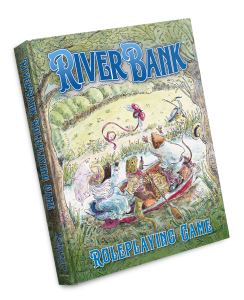
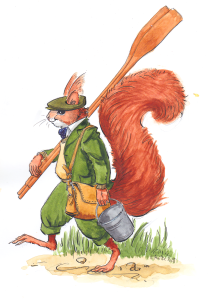
RiverBank is a cozy TTRPG of animals and whimsy, created and written by Kij Johnson and published by Kobold Press. The book is 192 pages and the print version includes a foldout map. Character sheets and pre-generated characters can be downloaded for free at the RiverBank site. Card decks for use in the game will also shortly be available. The artwork is in a lightly colored watercolor style that works well with the themes of the game as does the graphic and typographic design. Player characters are anthropomorphized animals helping others and taking on minor troubles. The book makes clear in the first few pages that this is not a game of epic heroic fantasy.
Mechanics
The game resolves tasks by the gamemaster determining a target number for the task and the player responding with a challenge number that includes a die roll. If the result is equal to or higher than the target number the character succeeds. If not, the player can accept the failure or succeed by use of stats or using animality/poetry points.
Animality/Poetry
Animality/Poetry is a sliding scale, with Animality representing a character’s baser animal instincts and Poetry representing your creativity. Each character begins the game at the center (zero) on the scale and avoiding absolute Animality or Poetry can prove useful in the game.
Dice
Players use 4, 6, 8 and 10 sided dice. They also use special 12 sided dice that generate a number between 0-3. These dice can be replaced with a standard d4, treating the d4 as a zero.
Gamemasters will also use a d20 and percentile dice.
Cards
The game also uses cards: the Betweentimes card deck and the Haphazardry card deck. These decks can be purchased, but the book also includes tables in the Appendices to allow the use of a standard deck of cards in place of these decks.
The Setting
The setting of RiverBank includes poetic Animals such as the player characters as well as ordinary animals who don’t speak and have standard animal intelligence.
The book includes descriptions of specific areas in the RiverBank and details that can be used in situations.
Characters
To create a character each player chooses an animal type which gives you preliminary stats which you can later modify. There are 16 standard sorts of animals which represent small mammals and birds. They then select three peculiarities and four knacks and roll for one insufficiency.
The player character stats are Charm, Intrepidity (bold, dauntless), Pother (fuss or trouble), and Sense (level headedness). Peculiarities give you abilities you can use in the game.
Game Play
The game uses Betweentimes to describe what happens in between game sessions. This is similar to downtime in games such as Blades in the Dark. During this section each player draws a Betweentimes card which helps define what their character has been doing during the time between sessions. The gamemaster then describes the situation and the goal of the session.
The game offers guidelines to the gamemaster for structuring the initial situation and maintaining the pacing of the story within the game. The book is great for newer gamemasters with advice peppered in about things like how often players should roll. There’s an extensive discussion of how to effectively determine a target number.
The challenge number the player creates is based on the total of a stat plus the roll of 1d6 and adding any knacks, peculiarities and insufficiencies which might apply. If the challenge number equals or exceeds the target number the character is successful.
Other Information
The book includes options for running sessions without a gamemaster which will be useful for some groups. It also gives advice for running longer term campaigns in RiverBank.
Adventures
The final chapter of the book includes four situations, and one other intended for solo play. There are also seeds for gamemasters to use to build scenarios.
Conclusion
RiverBank is a well conceived cozy game, meaning the stakes are low. While characters deal with the threat of failure, these threats are world-ending. The game could be played with a soft tone of comfort or a lighthearted humorous tone, whichever suits the table.
The book goes to great lengths to give advice to new players and gamemasters whether they’re new to this style of RPG or completely new to RPGS. This results in a lot of text which might seem intimidating at first, but the players who continue on will be rewarded with an inspiring game.
About the Author